
Father's Name Spelling Mismatch in Documents in Tripura
Families come to us convinced somebody was careless. Almost always nobody was. A name written in Bengali or Kokborok and then written again in English produces more than one correct answer, old registers recorded a first name and nothing else, and household names reached school records without anybody intending it. Understanding which of those produced your particular difference tells you whether to correct a record, leave it alone, or do something else entirely.
List every version and which document carries it, then work out what produced each difference, because a transliteration split and a missing surname need different answers. Settle one version from his own documents. Then correct only the records that matter for what you are actually doing, and cover the rest with linking evidence. Correcting everything is rarely necessary and is how families spend a year on this.
Father's name mismatches at a glance
- Is it somebody's mistake?
- Usually not. Most causes are structural rather than careless
- The biggest cause here
- Transliteration from Bengali or Kokborok into English
- The second
- Old registers holding a first name and no surname
- The one people miss
- A household name reaching a school record
- Does every record need fixing?
- No. Fix what your purpose requires
- What decides the version
- His own documents
- The cheap instrument
- A sworn statement linking the versions
- Where that fails
- Boards, passport counters and verification panels
- When publication is right
- When his own records disagree with each other
- The order
- Aadhaar, PAN, then the rest, boards last
Key takeaways
- More than one English spelling of a Bengali or Kokborok name can be correct.
- A missing surname in an old register is a different problem from a misspelling.
- A household name in a record is a different name, not a variant.
- Identify the cause before choosing the instrument.
- Correct what your purpose needs, and link the rest.
- Where his own records disagree, he settles it rather than you patching it.
The six causes, and why the cause decides the cure
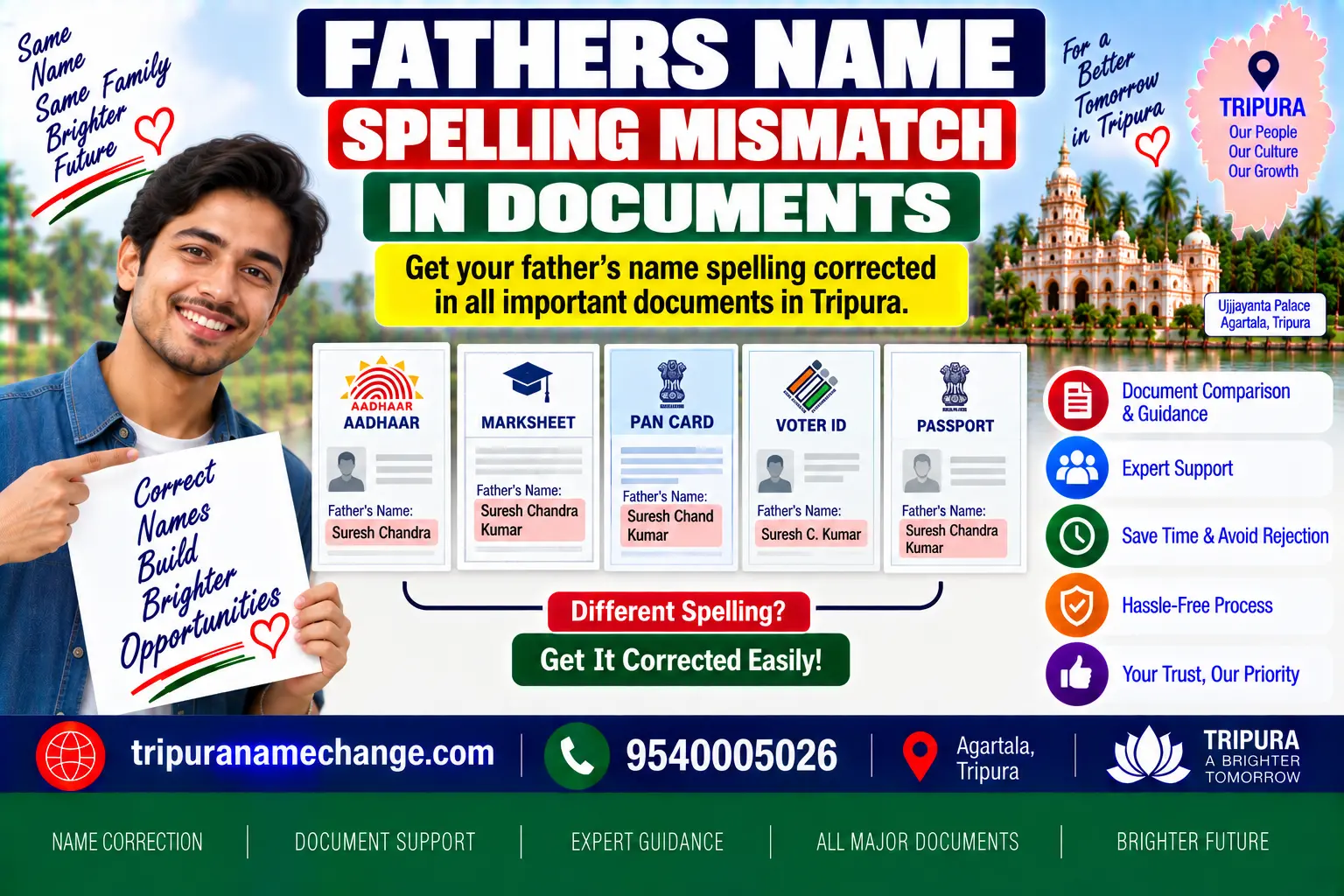
Every one of these looks the same when you lay the documents out: two papers, two versions of one man's name. They are not the same problem, and treating them alike is why people apply for the wrong thing.
| Cause | What it needs |
|---|---|
| Transliteration | A decision about which English form to use. Neither is wrong |
| Only a first name in an old record | Not a spelling fix. An addition, or linking evidence |
| A household name in a record | A different name altogether, needing a decision rather than a correction |
| An honorific written in | Removal, where a title was recorded as part of the name |
| A genuine writing error | A straightforward correction at the issuing office |
| He changed his own name | Nothing to correct. Produce his published notice |
Work out which row you are in before you spend anything. The rest of this page takes the three that are peculiar to Tripura and explains them properly.
Transliteration, and why neither version is wrong
A name that lives in Bengali or Kokborok has no single official English spelling. Whoever filled a form chose a reasonable way to write the sound, and somebody else later chose a different reasonable way. Both were doing their job properly. That is why arguing that one is a mistake rarely persuades anybody, and why the useful question is which form to standardise on rather than which is correct.
| Type of split | What happens |
|---|---|
| One word or two | A community surname written joined in one record and separated in another |
| Consonant choice | The same sound written with different letters by different clerks |
| Vowel length | A doubled vowel in one record and a single one in another |
| An ending | The final syllable written differently, changing how the name sorts and searches |
| Bengali surname variants | Long established alternative English forms, all in ordinary use |
| Script history | Kokborok has been written in more than one script, so older records came through a different route |
The detailed treatment, with the actual variant families and why they exist, is on Kokborok and Bengali name spelling variations, and the community surname question is on community surname spelling.
When an old record holds only a first name
This is common in older school and revenue records, where a parent gave a first name and the register recorded exactly that. Decades later a certificate says one word and every modern document says two, and it looks like something was lost. Nothing was lost; less was asked for.
It matters because the instrument is different. A misspelling is corrected. A shorter recorded name is not corrected so much as explained, and offices treat the two differently.
What usually works
- Linking evidence showing the fuller name in use at the time
- A sworn statement that both refer to one man
- Siblings' records showing the same pattern
- His own contemporaneous documents
What usually does not
- Insisting the old register is wrong
- Expecting a board to add a surname it was never given
- Producing only recent documents
- Treating it as a spelling correction application
A court has recognised that an inadvertently omitted or added surname is not the same thing as giving false information, which is worth knowing if anybody ever frames it that way. That case is discussed on father's name mismatch in a caste certificate.
When a household name reached an official record
Many families use one name at home and another on paper. Where the home name found its way into a school register, the result is not two spellings of one name. It is two different names, and applications that treat it as a spelling matter get refused, which puzzles everybody involved.
Where it is genuinely two names, the choice is between keeping both linked and replacing one with the other, and the notice wording differs between those two outcomes. That is worked through on two names in different documents.
How an office reads each kind of difference
Officers are not hunting for reasons to refuse you. They are asking whether the papers in front of them describe one person, and different kinds of difference make that question easy or hard.
| Difference | How it reads |
|---|---|
| One letter, same sound | Easy. Recognisably the same name |
| Joined or separated surname | Easy, and familiar to any Tripura office |
| Surname present in one, absent in the other | Harder, because something is missing rather than different |
| An initial against a full name | Harder still. It reads as a different string |
| Two unrelated names | Hardest, and no explanation substitutes for a document |
| Anything volunteered by you first | Easier than the same thing discovered by them |
The last row is free and most people do not use it. Explaining a difference before you are asked about it changes the conversation completely.
Working through a mismatch
List every version
And which document carries each, written out exactly.
Name the cause
Transliteration, missing surname, household name, honorific, error.
Settle one version
From his own documents, not from a majority vote of yours.
Decide what you need
A job application needs different records from a property matter.
Correct only those
Starting with Aadhaar, then PAN.
Link the rest
A sworn statement, kept in the folder whether or not it is asked for.
Deciding which records are worth correcting
Nobody needs every document they own to carry the same version. What they need is for the documents a particular purpose examines to agree. Working out which those are turns an overwhelming job into a small one.
| What you are doing | What has to agree |
|---|---|
| A Government recruitment | Board certificates, category certificate, identity documents. The strictest case |
| A passport | The documents you produce at the counter, compared line by line |
| Higher education admission | Board and university records, and the category certificate |
| A bank or employer | Identity documents, usually with a sworn statement accepted |
| Property or revenue matters | Land and family records, which have their own version to match |
| Nothing in particular | Then correct the cheap ones and leave the slow ones |
The last row is the honest advice for a great many people. If no deadline exists, correct Aadhaar and PAN because they are quick and cheap, keep a sworn statement, and leave the board correction until something actually requires it.
Linking evidence, and where it stops working
A sworn statement that several versions refer to one man is quick, cheap, and genuinely useful. It is also the most oversold document in this field, so it is worth being precise about where it stops.
Commonly accepted
- Banks and insurers
- Private employers
- Colleges for admission formalities
- Utilities and housing societies
Commonly refused
- Boards amending their own records
- Passport counters
- Recruitment verification panels
- Where a major change is claimed
Other things support it usefully: his own documents, siblings' certificates showing the same pattern, and any contemporaneous record using the fuller form. None of them replaces the correction where a panel requires one. The wording is on the affidavit page.
A worked example
An illustration rather than a real client, written to show the triage working. It is not a real person.
The situation. A woman in Unakoti district finds her father's name written three ways. Her Class 10 certificate has the surname as one word. Her Aadhaar has it as two words. Her birth certificate has only his first name and no surname at all. She needs a category certificate reissued and may apply for a state post next year.
Naming the causes. Two of these are different problems. The certificate against the Aadhaar is a transliteration split, where neither version is wrong. The birth certificate is not a spelling difference at all; the register was given a first name and recorded exactly that.
Settling the version. Her father's own documents use the one word form, which also matches her Class 10 certificate. That settles it, and usefully the two anchors agree, so no hard choice arises.
What she corrects. The Aadhaar entry, because it is quick and everything verifies against it. Then the category certificate, since that is the immediate need and it is reissued against family records. She leaves the birth certificate alone, because nothing she is doing examines it and adding a name to an old register is a separate application with its own rules.
What she keeps. A sworn statement covering all three versions, in the folder, whether or not anybody asks. If the state post materialises, her board certificate and category certificate already agree, which is what a panel compares.
How long each route takes
| Route | Speed |
|---|---|
| A sworn statement | Same day, and worth having regardless |
| Aadhaar and PAN corrections | Quick, and the cheapest in the whole sequence |
| Category or residence certificate | Weeks, through the SDM office or the portal |
| A published notice | Commonly 30 to 45 days after filing, plus the newspaper stage |
| A board correction | The slowest, and it decides any timetable it appears in |
| Adding a name to an old register | Its own application, with its own time limits |
Reading that table alongside the triage table above usually answers the question people actually came with, which is what they can realistically finish before a date.
What sorting this out costs
| Item | Position |
|---|---|
| A sworn statement | Stamp paper and a notary charge |
| Aadhaar and PAN | Small fees set by the authorities and revised |
| Reissued certificates | The department's own service fee |
| Board correction | The board's fee per certificate, with time as the real cost |
| A published notice | Commonly Rs 1,100 for an adult on BharatKosh, plus two newspapers |
| Our advice on which you need | None |
The largest saving available here is not a discount. It is not correcting records that nothing requires. The full picture is on name change cost in Tripura.
When publication is the right answer to a mismatch
Not for an ordinary transliteration split, where a sworn statement and one corrected record usually do the work. It earns its cost when his own documents disagree with each other, because then nothing can be produced as the settled version, and when a slow board correction cannot finish before a date that matters.
| Situation | Publish? |
|---|---|
| A transliteration split, his documents agree | No. Correct what your purpose needs and link the rest |
| His own documents disagree with each other | Yes, by him, settling one version for the whole family |
| Your board record is the outlier and a date is close | Often yes, as the faster instrument |
| Two genuinely different names | Yes, and the wording differs depending on whether both are kept |
| An old register holds only a first name | Usually no. Linking evidence is the ordinary answer |
| He changed his name years ago | No. Produce his existing notice |
What goes into the file
A Central Gazette file is five papers and the Department accepts or returns it as a whole. Nothing is returned to you afterwards, so it is assembled once and assembled properly.
| Paper | What it must say or be |
|---|---|
| 1. The affidavit | On non-judicial stamp paper, notarised in person, giving the old name, the new name, the address and the reason. The one step nobody can do online |
| 2. Two newspaper pages | One Bengali daily and one English daily circulating in Tripura, identical wording, and the complete original page of each with masthead and date. A cutting is refused |
| 3. The CD certificate | A declaration that the soft copy matches the hard copy, accepting responsibility for any mismatch. The most commonly forgotten paper in the file |
| 4. The request letter | Addressed to the Controller, Publication Department, Civil Lines, Delhi 110054 |
| 5. The proforma, in two copies | Computer typed, not handwritten, signed in the existing old name, with two witnesses giving signature, full name and full address |
What the notice actually says
Where a record was written wrongly, the correction style is used. Where your father is adopting a different name going forward, the change of name style is used instead. The exact wording is drafted for each case.
Correction style, where a record is wrong
No. ADVT IV /
PUBLIC NOTICE
It is for general information that I, [your full name], son of / daughter of [father's correct name], residing at [full address, district, Tripura, PIN], do hereby declare that the name of my father has been wrongly written as [the wrong version, quoted exactly as printed] in my [name the record, with roll number and year], whereas his actual and correct name is [the correct version]. Both the said names refer to one and the same person, namely my father.
[Signature in your existing name] • Witness 1 and Witness 2, each with signature, full name and full address
Change of name style, where he is adopting a new name
No. ADVT IV /
I, [father's existing name], son of [grandfather's name], residing at [full address, district, Tripura, PIN], hitherto known as [existing name], have changed my name and shall hereafter be known as [new name].
[Signed in the existing old name] • Witness 1 and Witness 2, each with signature, full name and full address
Three details decide acceptance. The wrong version is quoted exactly as printed, spacing and punctuation included, and never tidied, which matters here more than anywhere because the whole difference may be one space. Where several records carry it, each is named in turn with its own wrong version. And the proforma is computer typed in two copies, signed in the existing old name, with both witnesses giving a full address. Every variant is on the proforma format page.
The stages, and how it is filed from Tripura
Only one office in India accepts a personal name change file, the Department of Publication at Civil Lines, behind the Delhi Vidhan Sabha Metro Station, Delhi 110054, and there is no counter in Agartala. Our Delhi head office lodges it in person. The local part stays in Tripura: the affidavit sworn before a notary, and both newspaper notices booked together so the file is not waiting on one of them. The Government fee is commonly Rs 1,100 for an adult and Rs 1,700 for a minor, paid on BharatKosh only, non-refundable and revised each financial year, with our service charge always given as a separate line before anything is paid. Publication appears in Part IV commonly 30 to 45 days after filing, on a weekly release cycle, and the copy is a free PDF from egazette.gov.in that never expires and needs no attestation for use in India. The full route is on Gazette name change in Tripura.
Mistakes in mismatch cases
Diagnosis
- Treating a transliteration split as somebody's error
- Treating a missing surname as a spelling problem
- Treating two different names as two spellings
- Choosing the version by majority vote of your own papers
Execution
- Correcting every document you own
- Starting the slowest route with weeks to spare
- Relying on a sworn statement where a panel is involved
- Waiting for the officer to notice rather than saying it first
Words used here, explained
The vocabulary of a name mismatch, defined plainly.
- Transliteration
- Writing a name from one script into another by sound. Because more than one spelling can represent the same sound, it produces differences in which neither version is wrong.
- Household name
- The name a family uses at home, distinct from the name used on paper. Where it reached an official record, the result is two names rather than two spellings.
- Honorific
- A title of respect. Where one was recorded as part of a name, removing it is the correction rather than changing any spelling.
- Linking evidence
- Documents and sworn statements showing that different written versions belong to one man, used where correcting every record is unnecessary.
- One and the same person affidavit
- The sworn statement naming each version and declaring they refer to one man. Accepted by banks and employers, refused by boards and panels.
- Settled version
- The single form, written out exactly, that chosen records will be brought to. It comes from his own documents rather than from a majority of yours.
- Outlier
- The one record differing from the rest. Where a single outlier exists, correcting it is the cheapest route available.
- Anchor document
- The record others are compared against, usually the Class 10 certificate, which is why its version carries so much weight in verifications.
- Contemporaneous record
- A document made at about the same time as the one in dispute. It carries more weight than a recent document when explaining an old entry.
- Correction against change
- A correction fixes a record that was wrong when made. A change records a new name going forward and is published rather than corrected.
- Part IV
- The section of the Gazette of India carrying notices from private people, where a settled name is published.
- Central Gazette
- The Gazette of India, published by the Department of Publication at Civil Lines, Delhi. It settles which name is his and does not itself edit any record.
Mismatch help from every district of Tripura
Send the versions and the documents carrying them, and we will name the cause.
Mismatch questions people in Tripura search
Why is his name written differently everywhere?
Usually transliteration, which produces more than one correct English spelling.
Who made the mistake?
Often nobody. Most of these causes are structural.
Do I have to fix every document?
No. Fix what your purpose examines and link the rest.
My father's old certificate has no surname.
That is not a spelling problem. It needs linking evidence, not a correction.
Will an affidavit be enough?
For banks and employers usually. For boards and panels no.
When is publication worth it?
When his own documents disagree, or a board cannot finish in time.
Send us the versions
Send every document carrying his name, along with one of his own. We will name which cause produced each difference, tell you which single version to settle on, and say plainly which records are worth correcting for what you are actually doing and which can be left alone. Most people arrive expecting a long list and leave with a short one, and that is usually the most valuable thing we do here.
- 📞Call 9540005026
Monday to Saturday, 9 AM to 6 PM - WhatsApp 9540005064
Send your scans here, it is the fastest way - ✉️info@tripuranamechange.com
- 📍Tripura office: Associate Chamber at, Capital Complex, Agartala, Tripura - 799010
- 🏛️Head office: Metro Pillar 337, Hardev Nagar, Street 1, Shop No 1 (Shri Sham Documentation), Delhi 110084
Father's name mismatches, frequently asked questions
Why does his name appear in several forms?
Who made the mistake?
Do I have to correct every document?
His old certificate has a first name and no surname.
How do I tell a spelling difference from two different names?
Which version should I settle on?
Will a sworn statement be enough?
Should I mention the difference or wait to be asked?
What if nothing is pending at the moment?
When is a published notice the right answer?
The difference is only a space in a surname.
Could an omitted surname be treated as false information?
People also search for: father name different in aadhaar and marksheet, one and the same person affidavit, surname missing in old certificate, debbarma spelling variations, father name correction documents, name mismatch affidavit format.
Official sources
- Unique Identification Authority of IndiaWhat Aadhaar records and the rules for updating it.
- Income Tax DepartmentPAN corrections and the Aadhaar link.
- Tripura Board of Secondary EducationThe board route where a certificate is the record that must change.
- e-District TripuraReissued category and residence certificates.
- Department of Publication, Government of IndiaWhere a settled name is published, in Delhi.
- e-Gazette, Directorate of PrintingWhere a published notice is searched and downloaded free.
The short version
- Most of these differences are structural, not somebody's carelessness.
- Name the cause before choosing an instrument.
- Settle one version from his documents, not from a majority of yours.
- Correct only what your purpose examines, and link the rest.
- Say the difference out loud before an officer finds it.
Find out how short your list really is
Send the versions and we will tell you which records actually need correcting.